Difference Between Tornado Watch and Warning: Know Before It’s Too Late in 2026

Introduction
The sky turns green. The wind goes completely still. Your phone screams with an emergency alert. In that moment, do you actually know what to do?
Most people hear the words “tornado watch” and “tornado warning” and treat them as the same thing. That single mistake can cost you precious minutes when every second counts. Understanding the difference between tornado watch and warning is not just useful trivia. It is genuinely life-saving information.
Every year, tornadoes kill an average of 70 people in the United States alone, according to the National Oceanic and Atmospheric Administration. Many of those deaths happen because people underestimate the alerts or simply do not understand what those alerts are telling them to do.
This article breaks down everything clearly. You will learn exactly what each alert means, who issues them, how long they last, what actions you need to take, and how to stay prepared before the sky ever turns dark. Let us get into it.
What Is a Tornado Watch?
The Conditions Are Right for a Tornado
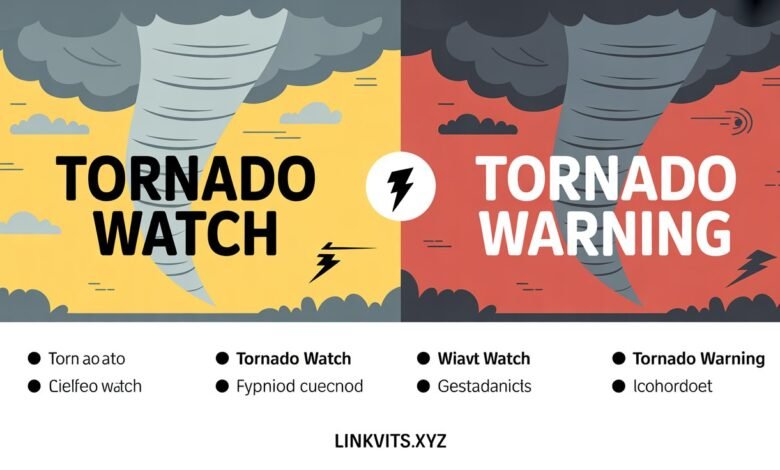
A tornado watch means that conditions in your area are favorable for tornadoes to develop. No tornado has formed yet. The atmosphere is simply charged and ready. Think of it as nature setting the stage.
The Storm Prediction Center, which is part of the National Weather Service, issues tornado watches. They cover large geographic areas, often stretching across multiple counties or even multiple states. A typical tornado watch area spans around 25,000 square miles.
Watches usually remain in effect for several hours. A common duration is four to eight hours, giving forecasters time to monitor how the weather evolves.
What You Should Do During a Tornado Watch
When a tornado watch is issued, you should not panic. But you absolutely should prepare. This is your window to act before the situation escalates.
Here is what to do during a tornado watch.
- Know where your safe shelter is located in your home or building.
- Charge your phone and make sure you have a weather alert app or radio.
- Gather emergency supplies including water, flashlights, and medications.
- Stay tuned to local news or a NOAA Weather Radio for updates.
- Make sure everyone in your household knows the plan.
- Avoid unnecessary travel, especially in open rural areas.
A tornado watch is your preparation window. Use it well. Once the situation upgrades, you will be grateful you took those steps early.
What Is a Tornado Warning?
A Tornado Has Been Confirmed or Detected
A tornado warning is far more urgent than a watch. It means a tornado has either been spotted by a trained weather spotter or detected on Doppler radar. The danger is immediate and real.
Local National Weather Service offices issue tornado warnings. Unlike watches, warnings cover much smaller geographic areas. They typically apply to a specific county or portion of a county. The area is often described using compass directions and specific towns or landmarks.
Warnings are short. They usually last between 30 and 60 minutes. That reflects the fast-moving nature of tornadoes themselves.
The Difference in Scale Is Critical
When I think about how people react to these two alerts, the biggest problem I see is people treating a warning with the same low urgency as a watch. That gap in understanding is dangerous.
A watch covers a huge region and says “be ready.” A warning covers a tight area and says “act right now.” The geographic scope alone tells you everything about how differently you should respond.
During the 2011 Joplin, Missouri tornado, 161 people lost their lives. Post-disaster research showed that many victims received the warning but did not take immediate shelter. Awareness of what a warning truly demands might have saved some of those lives.
What You Must Do During a Tornado Warning
You need to move immediately. There is no time to gather belongings or debate options.
Follow these steps the moment you hear a tornado warning.
- Go to the lowest floor of a sturdy building immediately.
- Move to an interior room away from all windows.
- Get under a staircase, in a bathtub, or inside a closet on an interior wall.
- Cover your head and neck with your arms or a heavy blanket.
- Do not try to outrun the tornado in a vehicle unless you are far from its path.
- If you are outside with no shelter available, lie flat in a low-lying ditch and cover your head.
Do not wait. Do not look out the window to see what it looks like. Move to your safe place first and stay there until the warning expires or authorities confirm the threat has passed.
Tornado Watch vs Warning: A Side-by-Side Comparison
Here is a clean breakdown that helps you remember the difference instantly.
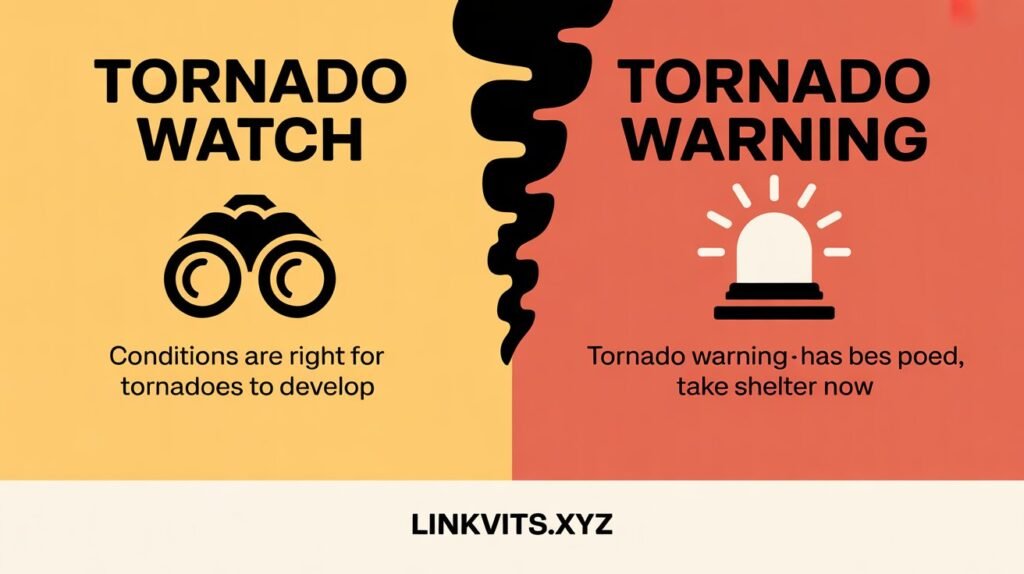
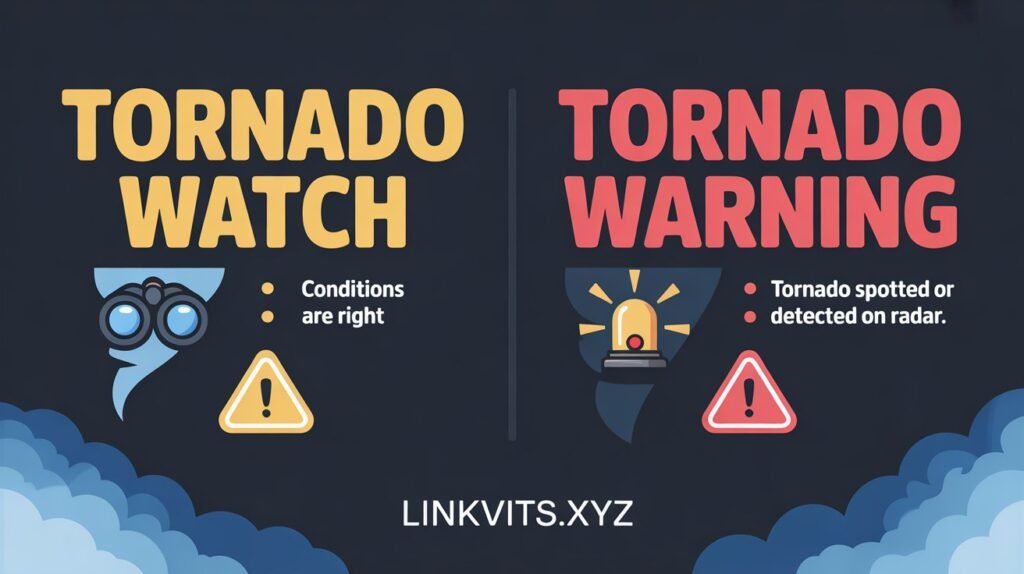
Tornado Watch: Issued by: Storm Prediction Center Coverage area: Large, often multiple counties or states Duration: Typically 4 to 8 hours Threat level: Conditions are favorable, no tornado confirmed Action required: Prepare and stay alert
Tornado Warning: Issued by: Local National Weather Service office Coverage area: Small, specific county or portion of a county Duration: Typically 30 to 60 minutes Threat level: Tornado confirmed or strongly indicated on radar Action required: Seek shelter immediately
The core distinction is preparation versus action. A watch asks you to get ready. A warning demands that you move right now.
What Is a Tornado Emergency?
The Highest Level of Tornado Alert
Beyond a warning, there is one more level you need to know about. A tornado emergency is the most serious alert the National Weather Service can issue. It indicates a particularly dangerous and life-threatening tornado that is already causing or expected to cause catastrophic damage.
This alert uses phrases like “prepare for the worst” and “catastrophic damage is imminent.” It is reserved for situations involving violent tornadoes, typically those rated EF4 or EF5 on the Enhanced Fujita Scale.
If you ever receive a tornado emergency alert on your phone, shelter immediately without hesitation. There is no level of threat above this one.
How Does the National Weather Service Detect Tornadoes?
The Technology Behind the Alerts
You might wonder how forecasters know a tornado is forming before it even touches down. The answer lies in technology and trained human observation working together.
NEXRAD Doppler radar is the primary tool. This system detects wind speed and direction inside storm cells. When meteorologists see a specific rotation signature called a mesocyclone, they can issue a warning even before a tornado is confirmed on the ground.
Storm spotters are the human layer of the system. These are trained volunteers and professionals who position themselves near severe storms and report what they see directly to local National Weather Service offices. Their reports help confirm radar signatures and ground-truth the technology.
The combination of radar and human observation makes the current alert system far more accurate than anything that existed before the 1990s. Lead time for tornado warnings has improved dramatically. The average lead time before a tornado today is around 13 minutes, according to NOAA. That number may sound small, but it is enough time to save your life if you act immediately.
Common Myths About Tornado Watches and Warnings
Clearing Up Dangerous Misconceptions
A lot of people carry false beliefs about tornadoes and the alerts that come with them. These myths are worth addressing directly because acting on them can get you killed.
Myth: Opening windows reduces pressure damage. This is completely false. Opening windows wastes precious time you should spend moving to shelter. Modern research shows that the pressure difference during a tornado is not what causes most structural damage. Flying debris and sheer wind force are the real killers.
Myth: Highway overpasses are safe shelters. This is one of the most dangerous myths still circulating. Overpasses actually create a wind tunnel effect that increases wind speed and debris. Several people have died sheltering under overpasses. If you are in a vehicle, drive at a right angle away from the tornado path if you have time and clear visibility. Otherwise lie flat in a low ditch.
Myth: Tornadoes do not strike cities or certain geographic areas. Tornadoes have hit downtown Dallas, downtown Atlanta, and downtown Oklahoma City. No geography protects you. If conditions are right, a tornado can form anywhere.
Myth: A tornado watch means a tornado is already happening. As you now know, a watch means conditions are favorable but no tornado exists yet. Confusing a watch for an active tornado leads to unnecessary panic or, worse, desensitization that causes people to ignore future, more serious alerts.
How to Build a Tornado Safety Plan at Home
Preparation Is Everything
I cannot stress this enough. The time to make your tornado plan is not when the siren is already screaming. It is right now, on a calm and sunny day.
Walk through your home and identify the safest room. It should be on the lowest floor, in the center of the building, away from all windows and exterior walls. Bathrooms, closets, and spaces under staircases work well because they offer both interior walls and a protective structure overhead.
If you live in a mobile home, you need an external plan. Mobile homes are extremely vulnerable to tornado damage even in weaker storms. Identify a nearby sturdy building you can reach quickly.
Here is a simple home preparedness checklist.
- Identify your primary shelter room and a backup location.
- Keep a go bag in or near your shelter spot with water, first aid supplies, a flashlight, and extra batteries.
- Purchase a NOAA Weather Radio that activates automatically during severe weather alerts.
- Download a trusted weather app with push notifications for watches and warnings.
- Practice your shelter plan with all family members including children.
- Know your neighborhood’s warning sirens and what they sound like.
The more automatic your response becomes through practice, the faster you will act when real danger arrives.
Tornado Safety in Different Situations
What to Do When You Are Not at Home
Your plan needs to cover more than just your house. Tornadoes do not wait for you to be in a convenient location.
At school or work: Most schools and workplaces have tornado drills. Know your building’s designated shelter areas. Interior hallways on lower floors are typically the safest spots. Avoid gymnasiums, auditoriums, and large open-span areas with wide roofs.
In a vehicle: Vehicles offer virtually no protection against tornadoes. If a warning is issued while you are driving, get out of your car and move into a sturdy nearby building. Never try to outrun a tornado on a highway if it is nearby and closing in. If no building is available and the tornado is approaching, exit your vehicle and lie flat in a depression below road level, covering your head.
In a shopping mall or large building: Go to the innermost part of the ground floor. Avoid skylights and large windowed areas. Large retail stores with wide open floor plans are not ideal shelter but interior fitting rooms and bathrooms provide extra wall coverage.
Outdoors: If you are caught outside with no access to a building, move away from trees and cars, which can become deadly projectiles. Find the lowest possible ground, lie flat face down, and cover the back of your head with your hands.
Understanding Tornado Alerts on Your Phone
Wireless Emergency Alerts Explained
Your smartphone receives tornado warnings through the Wireless Emergency Alert system, which is a government service that pushes alerts directly to all compatible phones in a geographic area without requiring you to opt in.
These alerts make a loud, distinctive sound even if your phone is on silent or do not disturb mode. You cannot miss them unless your phone is completely off.
You should also consider downloading your local National Weather Service office’s app or a third party weather app like Weather Underground or the American Red Cross Emergency app. These apps can give you slightly earlier warnings by detecting your GPS location and pushing alerts the moment your specific area is threatened.
Knowing how these alert systems work lets you trust them more fully when they activate.
Conclusion
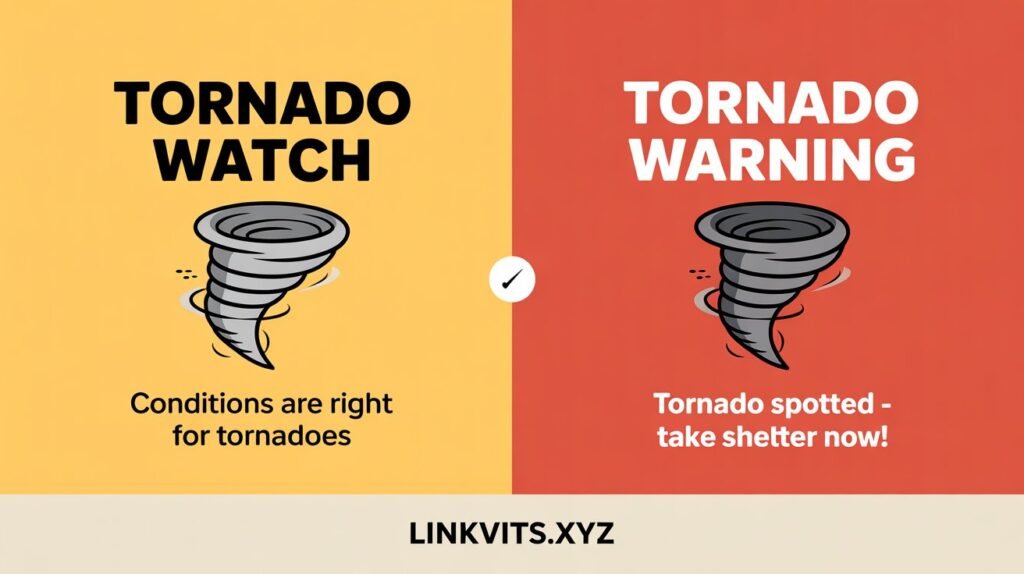
The difference between tornado watch and warning comes down to one critical distinction. A watch tells you to prepare because the ingredients for a tornado are present. A warning tells you to act immediately because a tornado is confirmed or imminent.
Both alerts deserve your full attention. Neither one should be dismissed or ignored. The gap in urgency between them is enormous, but both require a response.
You now know exactly what each alert means, who issues it, how long it lasts, and what you should do the moment you receive it. You also know about tornado emergencies, the myths to ignore, and how to build a solid preparedness plan before the sky ever changes color.
The best thing you can do with this knowledge is share it. Send this article to someone you care about. Talk through your safety plan with your family tonight. Put a NOAA Weather Radio on your shopping list.
What does your current tornado safety plan look like? Do you feel confident you would act fast enough if a warning came through right now? Think about that question honestly, because the answer might prompt you to prepare a little more than you already have.
Frequently Asked Questions
What is the main difference between a tornado watch and a tornado warning? A tornado watch means conditions favor tornado development but none has formed yet. A tornado warning means a tornado has been confirmed by a spotter or detected on radar and immediate action is required.
Which is more serious, a tornado watch or a tornado warning? A tornado warning is significantly more serious. It means the threat is immediate and real. A watch is a heads-up to prepare.
How long does a tornado warning last? Most tornado warnings are in effect for 30 to 60 minutes. You should remain sheltered until the warning expires or local authorities confirm the danger has passed.
What should I do during a tornado warning? Move immediately to the lowest floor of a sturdy building. Go to an interior room away from windows. Cover your head and neck and stay put until the threat clears.
What is a tornado emergency alert? A tornado emergency is the highest level of tornado alert. It indicates a violent, life-threatening tornado is occurring or imminent. It is reserved for the most catastrophic storm situations.
Can a tornado form without a tornado watch being issued first? Yes. Tornado watches are issued when conditions look favorable, but tornadoes can form quickly in situations that develop faster than forecasters anticipate. Always take any severe thunderstorm watch seriously.
Is a tornado watch the same as a severe thunderstorm watch? No. A severe thunderstorm watch indicates conditions for large hail and damaging winds. A tornado watch specifically indicates potential tornado development, though the two sometimes overlap.
Where is the safest place during a tornado? The safest place is a basement or interior room on the lowest floor of a sturdy building, away from all windows and exterior walls.
Are mobile homes safe during a tornado watch or warning? No. Mobile homes are extremely dangerous during any tornado threat regardless of category. Evacuate to a nearby sturdy building immediately when a watch is issued.
How much warning time do people usually get before a tornado hits? The average lead time before a tornado today is approximately 13 minutes according to NOAA. That makes immediate action during a warning essential, as there is very little time to spare.
Also Read Linkvits.xyz
About the Author: Claire Hartwell is an emergency preparedness writer and weather safety educator with over nine years of experience making complex meteorological information accessible to everyday readers. She has written extensively on severe weather preparedness, disaster response, and community safety planning. Claire believes that clear, accurate information is the most powerful tool people have when nature turns dangerous