Master Whole Numbers Definition: Complete Guide for Confident Math Success 2026

Introduction
Have you ever stopped to think about the numbers you use every day? When you’re counting apples at the grocery store, tracking your steps, or checking how many unread emails are sitting in your inbox, you’re working with whole numbers. They’re so fundamental to our daily lives that we often take them for granted. But understanding the whole numbers definition is more important than you might think—it’s the foundation of mathematics itself.
Whole numbers are the building blocks of arithmetic, and they’re surprisingly simple once you grasp the concept. In this guide, I’ll walk you through everything you need to know about whole numbers. You’ll learn what they are, how they differ from other number types, their essential properties, and why they matter in both mathematics and everyday life. Whether you’re a student refreshing your knowledge or someone who wants to understand math better, this article will give you a complete picture.
What Are Whole Numbers? The Core Definition
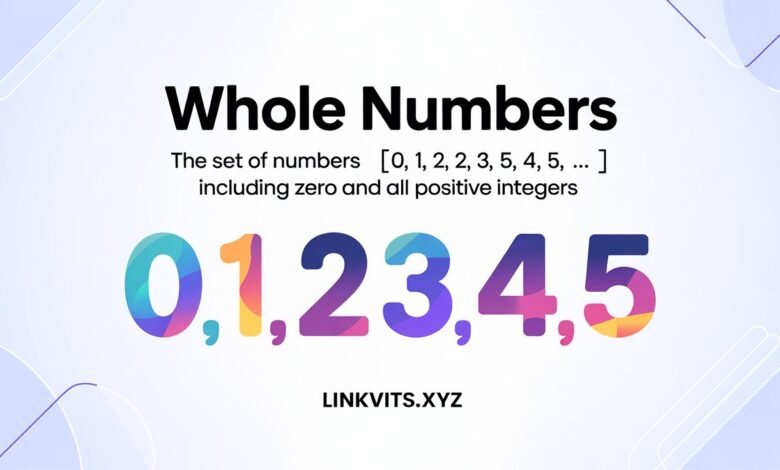
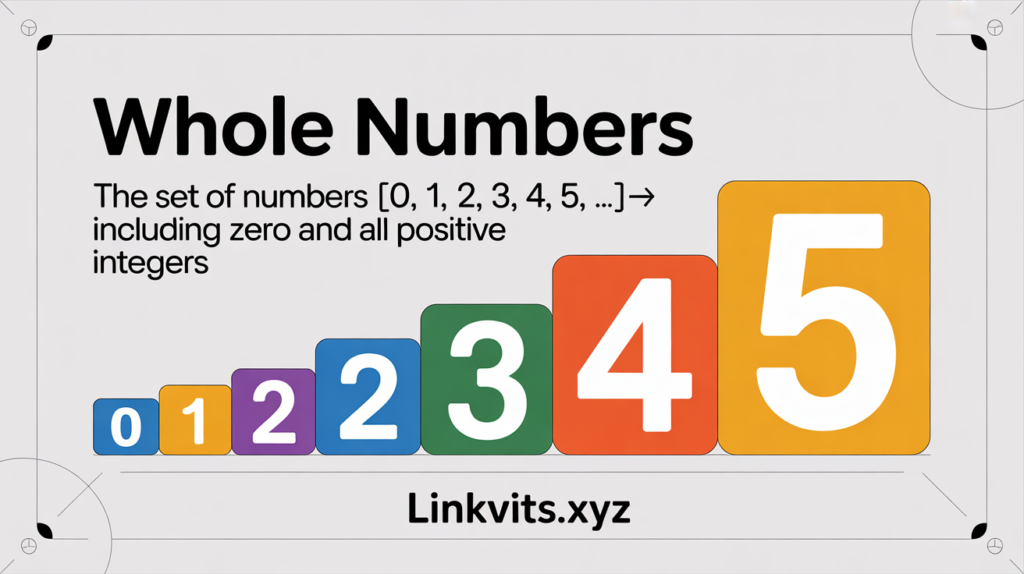
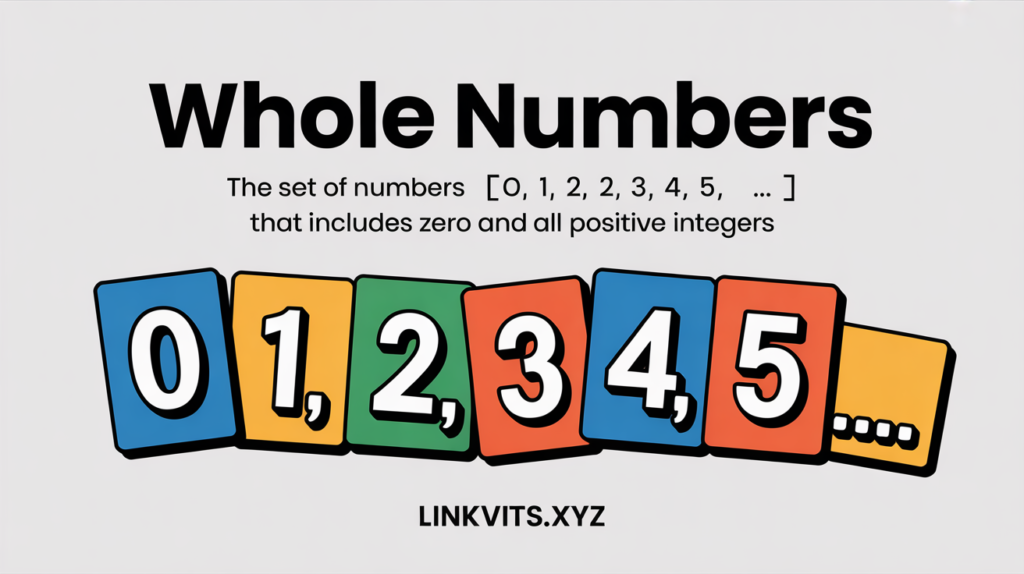
Let me start with the straightforward answer: whole numbers are the set of non-negative integers that include zero and all positive counting numbers. In mathematical terms, the set of whole numbers is written as {0, 1, 2, 3, 4, 5, 6, 7, 8, 9, 10, …} and continues infinitely.
Think of whole numbers as complete, unbroken units. They don’t include fractions, decimals, or negative values. When you count objects in the real world—like chairs in a room or cars in a parking lot—you’re using whole numbers.
The whole numbers definition is beautifully simple. These numbers represent quantities that are:
- Complete and undivided
- Non-negative (zero or positive)
- Not fractional or decimal
Here’s what makes whole numbers unique: they start at zero and march forward indefinitely. You can always add one more to any whole number and get another whole number.
The Mathematical Symbol for Whole Numbers
In mathematics, we use the symbol W or ℕ₀ to represent the set of whole numbers. You’ll see this notation in textbooks and academic papers. It’s a shorthand way of referring to the entire infinite set without writing out all the numbers.
The Historical Journey of Whole Numbers
Whole numbers have been with humanity since ancient times. Early civilizations used them for counting livestock, measuring grain, and tracking trade. The concept seems intuitive now, but it took centuries of mathematical development to formalize.
The ancient Babylonians, Egyptians, and Romans all had systems for representing whole numbers. However, one crucial element was missing for a long time: zero. The concept of zero as a number—not just the absence of quantity—was a revolutionary idea that emerged in India around the 5th century CE.
Zero transformed mathematics. It allowed for place-value notation and made complex calculations possible. Today, zero is an essential part of the whole numbers definition, even though it wasn’t always included historically.
Whole Numbers vs. Natural Numbers: What’s the Difference?
This is where many people get confused, and honestly, it’s understandable. The terms “whole numbers” and “natural numbers” are closely related but not identical.
Natural numbers are the counting numbers: {1, 2, 3, 4, 5, 6, …}. They start at one and continue infinitely. These are the numbers you use when counting objects naturally.
Whole numbers include all natural numbers plus zero: {0, 1, 2, 3, 4, 5, 6, …}.
The key difference? Zero. That single digit separates these two sets. While natural numbers represent counting (“I have three apples”), whole numbers can represent both counting and the absence of quantity (“I have zero apples”).
Here’s a simple way to remember it:
- Natural numbers = counting numbers (starting at 1)
- Whole numbers = natural numbers + zero
Some mathematicians and countries use different conventions, but in most modern American mathematics education, this distinction holds true.
How Whole Numbers Differ from Other Number Types
Understanding whole numbers becomes clearer when you see how they compare to other number sets. Let me break down the key differences.
Whole Numbers vs. Integers
Integers include all whole numbers plus negative numbers: {…, -3, -2, -1, 0, 1, 2, 3, …}. The set of integers extends in both directions from zero.
Whole numbers are actually a subset of integers—specifically, the non-negative integers. Every whole number is an integer, but not every integer is a whole number. Negative numbers like -5 or -100 are integers but not whole numbers.
Whole Numbers vs. Rational Numbers
Rational numbers can be expressed as fractions (ratios of two integers). This includes whole numbers, fractions, and terminating or repeating decimals.
All whole numbers are rational numbers because you can express any whole number as a fraction. For example, 5 can be written as 5/1. However, numbers like 1/2, 0.75, or 2.333… are rational but not whole.
Whole Numbers vs. Real Numbers
Real numbers include everything on the number line: whole numbers, integers, rational numbers, and irrational numbers (like π or √2).
Whole numbers represent just a tiny portion of the real number system. They’re the simplest, most fundamental numbers in the real number hierarchy.
Essential Properties of Whole Numbers
Whole numbers follow specific mathematical rules that make them predictable and useful. Understanding these properties helps you work with numbers more effectively.
Closure Property
When you add or multiply two whole numbers, you always get another whole number. Mathematicians call this the closure property.
Examples:
- 5 + 7 = 12 (whole number)
- 3 × 4 = 12 (whole number)
However, whole numbers are not closed under subtraction or division. Subtracting 8 from 5 gives you -3 (not a whole number), and dividing 5 by 2 gives you 2.5 (also not a whole number).
Commutative Property
You can add or multiply whole numbers in any order and get the same result.
Examples:
- 4 + 6 = 6 + 4 = 10
- 3 × 5 = 5 × 3 = 15
This property makes mental math easier. When adding a long list of numbers, you can rearrange them for simpler calculation.
Associative Property
When adding or multiplying three or more whole numbers, how you group them doesn’t change the result.
Examples:
- (2 + 3) + 4 = 2 + (3 + 4) = 9
- (2 × 3) × 4 = 2 × (3 × 4) = 24
Identity Property
Additive identity: Adding zero to any whole number gives you the same number (5 + 0 = 5).
Multiplicative identity: Multiplying any whole number by one gives you the same number (5 × 1 = 5).
These properties might seem obvious, but they’re fundamental to how mathematics works.
Distributive Property
This property connects multiplication and addition. It states that multiplying a number by a sum equals multiplying the number by each addend separately, then adding the products.
Example: 3 × (4 + 5) = (3 × 4) + (3 × 5) = 12 + 15 = 27
Real-World Applications of Whole Numbers
You encounter whole numbers constantly, often without realizing it. Let me share some everyday examples that demonstrate their practical importance.
Counting and Inventory
Every business uses whole numbers for inventory management. When a store tracks products, it counts in whole units. You can’t have 2.5 shirts in stock—it’s either 2 or 3.
Restaurants count customers, tables, and menu items using whole numbers. Manufacturing plants track production in complete units.
Financial Transactions
While money involves decimals for cents, we often think in whole dollar amounts. When budgeting or setting financial goals, people typically use whole numbers: “I want to save $5,000” or “I need $100 for groceries.”
Time Management
Hours on a clock, days in a week, weeks in a year—these are all whole numbers. You can’t have 3.7 days in a week; it’s a fixed set of 7 whole days.
Sports and Statistics
Sports statistics heavily rely on whole numbers. Teams score points, goals, or runs in whole numbers. Players wear jersey numbers that are whole numbers. Win-loss records use whole numbers.
Digital Technology
Computers fundamentally operate on whole numbers (binary: 0s and 1s). Everything digital—from the pixels on your screen to the data in your phone—is built on whole number foundations.
Population and Demographics
Census data, population counts, and demographic statistics use whole numbers. A city has a specific number of residents, not a fractional amount.
Operations with Whole Numbers
Understanding how to work with whole numbers is essential for mathematical literacy. Let me walk you through the basic operations.
Addition
Adding whole numbers is straightforward. Combine two or more numbers to find their total. The sum of whole numbers is always another whole number.
Tips for adding whole numbers:
- Line up numbers by place value
- Start adding from the rightmost column
- Carry over when sums exceed 9
Subtraction
Subtracting whole numbers finds the difference between them. However, remember that subtraction isn’t always closed under whole numbers.
When you subtract a larger whole number from a smaller one, you get a negative integer (not a whole number).
Multiplication
Multiplying whole numbers gives you products that are also whole numbers. Think of multiplication as repeated addition.
Example: 4 × 3 means adding 4 three times (4 + 4 + 4 = 12).
Division
Division is where whole numbers get tricky. Dividing whole numbers doesn’t always produce whole number results.
- 12 ÷ 3 = 4 (whole number)
- 13 ÷ 3 = 4.333… (not a whole number)
When division of whole numbers produces a whole number result, we call it “even division” or say one number “divides evenly” into another.
Common Misconceptions About Whole Numbers
Through my experience explaining mathematics, I’ve noticed several common misunderstandings about whole numbers. Let me clear these up.
Misconception 1: Whole Numbers Include Fractions
False. Whole numbers are complete, undivided units only. Numbers like 1/2, 3/4, or 2.5 are not whole numbers.
Misconception 2: Whole Numbers and Natural Numbers Are Identical
False. As I mentioned earlier, whole numbers include zero while natural numbers (in most definitions) start at one.
Misconception 3: Negative Numbers Can Be Whole Numbers
False. The whole numbers definition explicitly includes only zero and positive integers. Negative numbers are integers but not whole numbers.
Misconception 4: All Whole Numbers Are Even
False. Whole numbers include both even numbers (0, 2, 4, 6, …) and odd numbers (1, 3, 5, 7, …).
Misconception 5: You Can’t Do Division with Whole Numbers
Partially false. You can divide whole numbers, but the result isn’t always a whole number. Division is not a closed operation for whole numbers.
Teaching Whole Numbers to Students
If you’re helping someone learn about whole numbers, here are some effective strategies I’ve found helpful.
Use Visual Aids
Physical objects like blocks, counters, or drawings help students visualize whole numbers. Seeing five actual objects makes the abstract concept of “5” concrete.
Number Lines
A number line starting at zero and extending right helps students understand the sequence and spacing of whole numbers. It also clearly shows that whole numbers don’t go negative.
Real-World Examples
Connect whole numbers to everyday situations. Ask students to count items in the classroom, family members, or days until an event.
Interactive Games
Games that involve counting, addition, or subtraction with whole numbers make learning engaging. Board games, card games, and digital apps can all reinforce concepts.
Progressive Difficulty
Start with small whole numbers (0-10) before moving to larger ones. Master counting and simple operations before introducing properties and more complex concepts.
Advanced Concepts: Prime Numbers and Whole Numbers
Within the set of whole numbers, some special categories deserve attention. Prime numbers are particularly interesting.
A prime number is a whole number greater than 1 that has exactly two factors: 1 and itself. Examples include 2, 3, 5, 7, 11, and 13.
Not all whole numbers are prime. Numbers like 4, 6, 8, and 9 are composite numbers—whole numbers with more than two factors.
The number 0 and 1 are special cases. Zero is neither prime nor composite. One is also neither prime nor composite (by modern definition).
Prime numbers play crucial roles in mathematics, cryptography, and computer science. They’re the “building blocks” from which all whole numbers can be constructed through multiplication.
The Infinite Nature of Whole Numbers
One fascinating aspect of whole numbers is their infinity. No matter how large a whole number you think of, you can always add one to get a larger whole number.
This concept troubled ancient mathematicians. How can something be never-ending? The Greek mathematician Euclid proved over 2,000 years ago that prime numbers are infinite, which means whole numbers must also be infinite.
Understanding infinity in the context of whole numbers helps develop abstract thinking. It challenges our everyday experience where everything seems to have limits.
Whole Numbers in Different Number Systems
While we typically use the decimal (base-10) system, whole numbers exist in other number systems too.
Binary (base-2): Uses only 0 and 1. The whole number 5 in decimal is 101 in binary.
Octal (base-8): Uses digits 0-7. The whole number 10 in decimal is 12 in octal.
Hexadecimal (base-16): Uses digits 0-9 and letters A-F. The whole number 16 in decimal is 10 in hexadecimal.
Different number systems represent the same whole number quantities but write them differently. This is crucial in computer science and digital electronics.
Why Understanding Whole Numbers Matters
You might wonder why spending time on such a basic concept matters. The whole numbers definition is fundamental to all higher mathematics.
Without solid understanding of whole numbers, students struggle with:
- Fractions and decimals
- Algebra and equations
- Geometry and measurement
- Statistics and probability
- Calculus and advanced mathematics
Whole numbers also develop logical thinking. Understanding their properties and relationships builds reasoning skills applicable beyond mathematics.
In professional fields like engineering, finance, computer science, and data analysis, whole numbers are constantly used. Mastering them early creates a strong foundation for career success.
Conclusion
Whole numbers are the complete, non-negative integers starting from zero and extending infinitely: {0, 1, 2, 3, 4, …}. They’re the foundation of mathematics and an essential part of daily life. From counting objects to managing finances, from telling time to analyzing data, whole numbers surround us constantly.
Understanding the whole numbers definition, their properties, and how they differ from other number types gives you mathematical confidence. These simple yet powerful numbers follow predictable rules and enable complex calculations. They’re closed under addition and multiplication, follow commutative and associative properties, and have special identities with zero and one.
Whether you’re a student building mathematical skills or an adult refreshing your knowledge, appreciating whole numbers deepens your understanding of how mathematics works. They’re not just abstract concepts—they’re practical tools you use every single day.
What whole number concept do you find most interesting or useful in your daily life? Think about it next time you count, calculate, or measure something. Mathematics is everywhere, and it all starts with these foundational whole numbers.
Frequently Asked Questions
1. What is the smallest whole number?
Zero is the smallest whole number. The set of whole numbers starts at 0 and includes all positive integers from there (0, 1, 2, 3, …).
2. Is zero a whole number?
Yes, zero is definitely a whole number. It’s the first number in the whole number set. This distinguishes whole numbers from natural numbers, which typically start at 1.
3. Are all whole numbers integers?
Yes, all whole numbers are integers. However, not all integers are whole numbers. Integers include negative numbers, while whole numbers only include zero and positive integers.
4. Can whole numbers be negative?
No, whole numbers cannot be negative. By definition, whole numbers include only zero and positive integers. Negative numbers belong to the integer set but not the whole number set.
5. Is 5.5 a whole number?
No, 5.5 is not a whole number. Whole numbers must be complete units without fractional or decimal parts. 5.5 is a rational number but not a whole number.
6. What’s the difference between whole numbers and counting numbers?
Counting numbers (natural numbers) start at 1 and go up (1, 2, 3, …). Whole numbers include zero plus all counting numbers (0, 1, 2, 3, …). The key difference is the inclusion of zero.
7. Are whole numbers closed under division?
No, whole numbers are not closed under division. Dividing one whole number by another doesn’t always produce a whole number. For example, 7 ÷ 2 = 3.5, which is not a whole number.
8. How many whole numbers are there?
There are infinitely many whole numbers. The set starts at 0 and continues forever (0, 1, 2, 3, 4, …). You can always add 1 to any whole number to get another whole number.
9. Is every whole number a rational number?
Yes, every whole number is a rational number. Any whole number can be expressed as a fraction by placing it over 1. For example, 5 = 5/1, making it rational.
10. What are whole numbers used for in real life?
Whole numbers are used for counting objects, tracking inventory, recording scores, measuring time units, representing populations, managing finances in whole dollar amounts, and countless other daily applications where complete units are needed.
Also Read : Fathers Day Quotes