Introduction
Math has a reputation for being intimidating. But here’s something that might surprise you — one of the most useful tools in all of algebra fits into a single line. The distributive property is that tool, and once you truly understand it, a huge chunk of math starts making sense in a way it never did before.
The distributive property states that multiplying a number by a group of numbers added together gives the same result as doing each multiplication separately. That’s it. But don’t let the simplicity fool you — this idea shows up everywhere. From simplifying equations in algebra class to calculating a restaurant bill in your head, the distributive property is working quietly behind the scenes.
In this article, you’ll get a thorough, clear breakdown of what the distributive property is, how it works, where it comes from, and how to actually use it. Whether you’re a student trying to make sense of your homework or someone who wants to brush up on the fundamentals, this guide has got you covered.
What Is the Distributive Property?
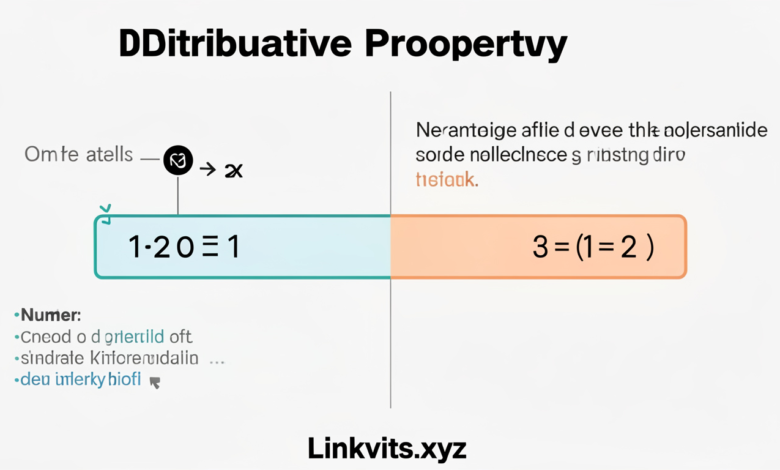
The distributive property is one of the fundamental properties of arithmetic and algebra. It describes how multiplication interacts with addition and subtraction. Formally, it looks like this:
a(b + c) = ab + ac
What that means in plain English: if you’re multiplying a number by a sum, you can “distribute” the multiplication to each term inside the parentheses and then add the results. The distributive property ensures that both approaches give you the same answer.
Here’s a quick, concrete example. Say you want to find 3(4 + 5). You could add first: 3(9) = 27. Or you could distribute: 3(4) + 3(5) = 12 + 15 = 27. Same answer, two different paths.
This might seem trivial with small numbers. But as expressions get more complex — especially in algebra — the distributive property becomes an essential tool for simplifying and solving problems.
The History Behind the Distributive Property
The distributive property isn’t some modern invention. Its roots trace back to ancient mathematics. The Babylonians used distributive-like reasoning as far back as 2000 BCE, though they didn’t formalize it the way we do today. Greek mathematicians, particularly Euclid, used geometric representations that mirror the distributive law — visualizing multiplication as areas of rectangles.
The formal algebraic expression of the distributive property became standardized through the development of symbolic algebra in the 16th and 17th centuries. Mathematicians like François Viète and later René Descartes helped create the notation system we still use today. By the time algebra was formalized as a discipline, the distributive property was already recognized as a cornerstone rule.
How the Distributive Property Works: Step by Step
Let’s walk through the distributive property carefully so the mechanics become clear.
Distributing Over Addition
The most common form is distributing a factor over a sum:
a(b + c) = ab + ac
Example: 5(x + 3)
Step 1: Multiply 5 by x → 5x Step 2: Multiply 5 by 3 → 15 Step 3: Write the result → 5x + 15
That’s the distributive property in action.
Distributing Over Subtraction
The same rule applies when you have subtraction inside the parentheses:
a(b − c) = ab − ac
Example: 4(2x − 7)
Step 1: Multiply 4 by 2x → 8x Step 2: Multiply 4 by 7 → 28 Step 3: Write the result → 8x − 28
Notice that the subtraction sign carries through. This is a common mistake point — forgetting to distribute the sign is one of the most frequent errors students make.
Distributing a Negative Number
When the factor outside the parentheses is negative, the distributive property still works — but now you need to be extra careful with signs.
Example: −3(x + 4)
Step 1: Multiply −3 by x → −3x Step 2: Multiply −3 by 4 → −12 Step 3: Write the result → −3x − 12
This trips a lot of students up. I always recommend writing out every multiplication step separately when a negative is involved, at least until it becomes second nature.
Distributive Property in Algebra
Once variables enter the picture, the distributive property becomes absolutely essential. Without it, you’d have no clean way to simplify expressions or solve equations involving parentheses.
Simplifying Algebraic Expressions
Example: 2(3x + 5) − 4x
Step 1: Apply the distributive property → 6x + 10 − 4x Step 2: Combine like terms → 2x + 10
That’s a tidy result from what started as a cluttered expression. The distributive property is what made the simplification possible.
Solving Equations with the Distributive Property
Here’s a slightly more complex scenario:
Example: Solve 3(x − 2) = 9
Step 1: Distribute → 3x − 6 = 9 Step 2: Add 6 to both sides → 3x = 15 Step 3: Divide by 3 → x = 5
Without knowing the distributive property, you’d be stuck at step one. With it, you can unlock the equation and solve for x.
The Distributive Property with Two Binomials (FOIL)
Here’s where things get a little more involved. When you multiply two binomials — like (x + 2)(x + 3) — you’re actually applying the distributive property twice. This is sometimes taught as the FOIL method (First, Outer, Inner, Last), but at its core, it’s just the distributive property applied systematically.
(x + 2)(x + 3)
Distribute (x + 2) over (x + 3): → x(x + 3) + 2(x + 3) → x² + 3x + 2x + 6 → x² + 5x + 6
Every step of FOIL is just the distributive property doing its work.
Distributive Property vs. Other Math Properties
It helps to see how the distributive property fits alongside the other major properties of arithmetic.
- Commutative Property: Changes the order — a + b = b + a
- Associative Property: Changes the grouping — (a + b) + c = a + (b + c)
- Identity Property: Adding 0 or multiplying by 1 leaves a number unchanged
- Distributive Property: Connects multiplication with addition/subtraction
The distributive property is the only one that bridges two different operations. That’s what makes it special. The commutative and associative properties work within a single operation. Distributive crosses the boundary — and that boundary-crossing is precisely why it’s so powerful in algebra.
Real-World Uses of the Distributive Property
You might be wondering — does the distributive property matter outside of math class? Absolutely. Here are a few practical situations where it quietly does the heavy lifting.
Mental Math
Say you’re at a store and you need to calculate 6 × 47 in your head. That’s not immediately obvious. But if you use the distributive property:
6 × 47 = 6 × (40 + 7) = 240 + 42 = 282
Breaking 47 into 40 + 7 makes each multiplication manageable. This is how mental math shortcuts work — and the distributive property is the reason they’re valid.
Splitting a Bill
Imagine you and two friends each ordered the same meal that costs $12.50, plus a $3 dessert each. You want to figure out the total.
3 × (12.50 + 3) = 3 × 12.50 + 3 × 3 = 37.50 + 9 = $46.50
That’s the distributive property working in a restaurant booth.
Area Calculations
If you’re figuring out the area of a room that’s 8 feet wide and has two sections — one 10 feet long and another 5 feet long — the distributive property gives you:
8(10 + 5) = 8 × 10 + 8 × 5 = 80 + 40 = 120 square feet
These aren’t contrived examples. They’re the actual situations where distributing makes calculation faster and cleaner.
Common Mistakes with the Distributive Property
Even students who understand the concept make consistent errors. Here are the ones I see most often.
1. Only multiplying the first term. When you see 3(x + 4), some people only multiply the 3 by x and leave the 4 alone. The result is 3x + 4, which is wrong. Every term inside the parentheses gets multiplied.
2. Forgetting to distribute negative signs. With −2(x − 5), the result should be −2x + 10. Many students write −2x − 10. The sign has to be distributed, not just the number.
3. Mixing up distribution with combining like terms. The distributive property creates new terms. Combining like terms is a separate step. Trying to do both at once leads to confusion and errors.
4. Stopping halfway through. After distributing, always simplify. Leave nothing in unexpanded form when the question asks for a simplified expression.
The Distributive Property and Factoring: The Reverse Direction
Here’s something worth pointing out — the distributive property runs in both directions. Going from a(b + c) to ab + ac is expanding. Going from ab + ac back to a(b + c) is factoring. Both rely on the same property.
Example: Factor 6x + 9
What’s common to both terms? 3. So: 6x + 9 = 3(2x + 3)
You’ve reversed the distributive property to rewrite the expression in a more compact form. Factoring is one of the most important skills in algebra, and it’s entirely built on understanding the distributive property in both directions.
Distributive Property Across More Than Two Terms
The distributive property isn’t limited to two terms inside the parentheses. You can have three, four, or more.
Example: 2(x + y + z) = 2x + 2y + 2z
The rule is the same — every term gets multiplied by the factor outside. The number of terms doesn’t change the process at all.
Practice Problems
Try these on your own. The answers are below.
- 4(x + 6)
- −5(2x − 3)
- 7(a + b + 2)
- 3(4x − 1) + 2x
- (x + 4)(x + 2)
Answers:
- 4x + 24
- −10x + 15
- 7a + 7b + 14
- 14x − 3
- x² + 6x + 8
Why the Distributive Property Matters So Much in Higher Math
If you’re only using the distributive property to simplify homework problems, you’re seeing just the tip of the iceberg. This property is foundational to entire branches of mathematics.
In linear algebra, the distributive property appears in matrix operations. In calculus, it’s used constantly when expanding expressions before differentiating or integrating. In number theory, it underpins the way we reason about divisibility and prime factorization. Even in computer science, Boolean algebra — which governs how logic gates and circuits work — has its own version of the distributive property.
Understanding the distributive property deeply means you’re not just memorizing a rule for middle school math. You’re building a mental model that scales all the way up through advanced mathematics.
Conclusion
The distributive property is one of those ideas that looks simple on the surface but keeps showing up in increasingly sophisticated forms as you go further in math. At its heart, the distributive property tells you that multiplication distributes over addition — meaning you can break apart complex expressions into manageable pieces and then combine the results.
You’ve seen how it works with addition, subtraction, negative numbers, variables, and binomials. You’ve seen it used for mental math, bill splitting, and area calculations. You’ve seen how it runs in reverse to enable factoring. And you’ve gotten a glimpse of how it scales into higher mathematics.
The distributive property isn’t just a rule to memorize. It’s a way of thinking — a principle that makes complex things simpler by breaking them into parts. And in math, that skill is worth everything.
What’s a concept you’ve been struggling to understand that you think the distributive property might help unlock? Share it in the comments — let’s work through it together.
Frequently Asked Questions (FAQs)
1. What is the distributive property in simple terms? The distributive property says that a(b + c) = ab + ac. You multiply the outside number by each term inside the parentheses separately, then add the results. It’s a way of “distributing” multiplication across a sum or difference.
2. What is the distributive property formula? The core formula is: a(b + c) = ab + ac. For subtraction, it’s a(b − c) = ab − ac. These work for any real numbers or algebraic expressions.
3. Why is the distributive property important in algebra? Without the distributive property, you couldn’t simplify expressions that involve parentheses. It’s the key step that lets you clear parentheses and solve equations, factor expressions, and expand products of binomials.
4. What is an example of the distributive property? A clear example: 5(x + 3) = 5x + 15. You multiply 5 by x to get 5x, and 5 by 3 to get 15. That’s the distributive property applied.
5. Does the distributive property work with subtraction? Yes. For subtraction, a(b − c) = ab − ac. The key is making sure the subtraction sign carries through when you distribute. Forgetting the sign is one of the most common mistakes.
6. What is the difference between the distributive property and the commutative property? The commutative property deals with the order of operations within a single operation (like a + b = b + a). The distributive property connects two different operations — multiplication and addition — in a specific way.
7. How does the distributive property relate to factoring? Factoring is the distributive property in reverse. Instead of expanding a(b + c) into ab + ac, you take ab + ac and rewrite it as a(b + c) by pulling out the common factor.
8. Can the distributive property be used with three or more terms? Yes. a(b + c + d) = ab + ac + ad. Every term inside the parentheses gets multiplied by the factor outside. The number of terms doesn’t change the rule.
9. How is the distributive property used in real life? It’s used in mental math shortcuts (like calculating 6 × 47 by splitting 47 into 40 + 7), splitting costs among groups, and computing areas. Anytime you break a calculation into simpler parts and combine the results, you’re using the distributive property.
10. What grade do students learn the distributive property? In the United States, the distributive property is typically introduced in 3rd grade with simple multiplication, then revisited in 6th or 7th grade in the context of algebra and variable expressions. It continues to appear in math education all the way through calculus and beyond.
Also Read: Nick Aldis Is Proof That Dedication Always Wins Big 2026
| Author: Johan Harwen |
| E-mail: johanharwen314@gmail.com |
| Bio: Johan Harwen is a passionate tourist who has explored countless destinations across the globe. With an eye for hidden gems and local cultures, he turns every journey into an unforgettable story worth sharing. |